
Dementia awareness e-learning course
This e-learning course aims to raise the awareness and skills of care staff who work with people with dementia. It aligns with Tier 1 of the National Dementia Training Standards Framework, which is a requirement for all staff working in social care. It will also allow you to collect evidence towards the relevant section of the Care Certificate.
The course seeks to improve the wellbeing and experience of people with dementia and of the care staff working with them. It should improve your confidence in managing situations you find challenging.
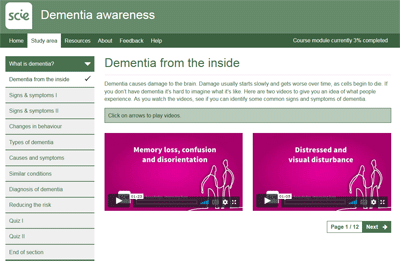
Course content
- What is dementia?
- Living well with dementia
- Talking to people who are living with dementia
Learning outcomes
- Explain what is meant by the term ‘dementia’
- Discuss the signs and symptoms of dementia
- Differentiate dementia from other similar conditions
- Explain why early diagnosis is important
- Discuss what people can do to reduce their risk of developing dementia
- Explain what is involved in ‘living well’
- Discuss the importance of recognising what’s important to people
- Discuss how dementia affects the person, their family and our wider society
- Understand how to communicate effectively and compassionately with individuals who have dementia
- Understand why a person with dementia might show signs of distress
- Begin to respond effectively to people with dementia who have different communication needs
Purchase for you and your colleagues
Standard price per learner: £55.00 + VAT
Discounts applied for orders of multiple licences.
Frequently asked questions
- activities workers
- assistant practitioners
- care assistants
- carers
- day care assistants
- domiciliary care workers
- healthcare support workers
- homecare workers
- maternity support workers
- nursing assistants
- personal assistants
- reablement assistants
- residential care workers
- senior homecare workers
- support workers
- volunteers
- and other health or care assistant-related roles
The CQC require organisations to deliver care in a way that is safe, effective, caring and responsive. Organisations must also meet Care Act (2014) requirements and be well-led.
Caring for people in a way that is ‘person-centred’ (that meets the needs and wishes of people and their families) is at the heart of CQC and other legal requirements – because of this it is also the central focus of this course. Finding out what people need and want, being kind and treating people with dignity and respect, are all important aspects of the person-centred approach.
- Good quality early diagnosis
- Improved quality of care in general hospitals
- Living well with dementia in care homes
- Reduced use of antipsychotic medication
This awareness course has been developed to align with Tier 1 of the National Dementia Training Standards Framework, which is a requirement for all staff working in social care. It will also allow you to collect evidence towards the relevant section of the Care Certificate.
- Course content: A SCORM 1.2 or 2004 compliant version of the course.
- Course updates: We will supply you with course updates for an agreed period of time.
- Custom changes: We can help by making custom changes to the course to meet your specific learning and development needs.
This is always a difficult question to answer as no two people are the same. There are a number of factors to consider such as level of knowledge, reading speed and in which order the course is completed.
For that reason, our estimates are really quite broad. Analytics shows that learners take an average of 30 minutes to study the course.
v1.0 (May 2019): Original release of Dementia awareness course.
Previously: SCIE published a Dementia e-learning course, released in 2009. This new, 2019 released, Dementia awareness course replaces our 2009 Dementia course.
- The price stated is exclusive of VAT. Customers will be charged VAT at the UK’s standard rate in addition to the price stated.
- On receipt of payment, we’ll issue you, the customer, with course invite(s).
- You, the customer, will be able to issue course invites to your learners. Each learner must have a unquie and working email address, and must sign-up (or log into their existing) MySCIE account to accept the invite. MySCIE accounts are free.
- Course invites must be issued to, and accepted by, learners, within 90 days of purchase, otherwise the invite will expire.
- Learners are required to agree that their course progress is shared with you, the customer, before they can access the course.
- From accepting the invite, the learner will have 90 days access to the course.
- Please check the recommended devices / web browsers for this course, before purchase.
- Please check who this course is for, before purchase.
- An internet connection is required, with the ability to stream video content from YouTube.
- All material in these resources, including text, graphics, photographs, video and audio is copyright of the Social Care Institute for Excellence (SCIE), unless otherwise stated.
- Although SCIE’s courses have been used over many years with almost no reported problems, SCIE cannot provide technical support for their implementation or to investigate or fix any reported technical problems, nor does it warrant that they are fully compliant with all or any technical platform. Please review the recommended devices / web browsers advice.
- Video scenarios have been produced using actors. This approach has been adopted to protect the identities of individuals whose accounts have been drawn upon to create the scenarios. The professional reflections are provided by experts (i.e. real people) whose professional responsibilities involve ensuring the safeguarding of adults at risk.
- Chrome: Latest version
- Firefox: Latest version
- Microsoft Edge: Latest version
- Safari: Latest version
- iOS: 10
- Android: Marshmallow (6.0)
SCIE used to provide free access to the content of this course. This course is no longer available for free.